It is 2026 and you can see a seismic shift going on in the leather goods industry. Many of the top leather product manufacturer in Italy companies are blending bold innovation with precision engineering, to satisfy rising demands for customization, sustainability and efficiency. The days of traditional tanning vats and manual stitching are over now. You can easily find the leading names using cutting-edge technologies for the production of leather belts, bags, wallets and more – quickly and in an eco-friendly way. Take a look at how top manufacturers are transforming leather goods production this year.
AI-powered precision cutting and pattern making
Many of the leading manufacturers are now using computer vision systems and AI algorithms for optimal leather cutting results. These tools manage to scan hides in real time. Flaws are identified quickly and patterns are mapped with micron-level accuracy.
This manages to reduce wastage by up to 30%. It manages to improve yield as well as allow hyper-customization. The lead times get shorter and manufacturers can craft premium-quality products that look custom, without the premium price tag.
Sustainable bio-leather and lab-grown alternatives
The biggest manufacturing leather products in Italy companies are now using bioengineered leathers grown from the leaves of pineapple, cactus or mycelium. They are ditching chrome tanning. Such plant-based alternatives resemble genuine leather in texture and durability. It also helps to reduce the usage of water by as much as 90%. The use of harmful chemicals is eliminated as well.
Many companies are producing uniform hides at industrial speeds by scaling such materials through precision fermentation vats.
Robotic automation for flawless assembly
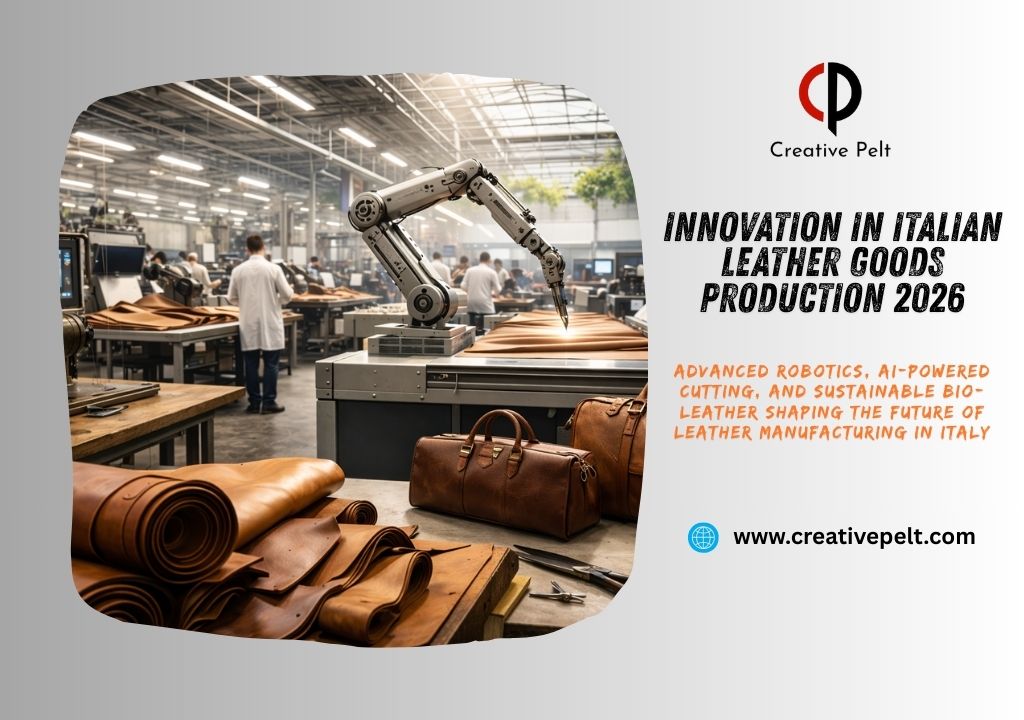
The use of advanced co-bots or collaborative robots is also prevalent. In many leather factories in Italy, such robots are handling stitching, edging and embossing with absolute accuracy and consistency. These are equipped with force-sensing grippers and can adapt to the natural variations of leather. It is possible to get uniform seams on oversized totes, slim wallets and everything in between.
3D printing for custom hardware and components
The 3D printing process is using on-demand, precision-molded pieces from recycled metals or bio-resins. These are bringing about a revolution in the hardware aspect of production. It is now easier for manufacturers to print lightweight zippers, clasps, and logos directly onto leather. Many companies are also embedding RFID chips for anti-counterfeiting.
Blockchain-tracked supply chains and digital twins
A number of manufacturers are using blockchain for transparency. Digital twins or virtual replicas of production lines are also being used for simulating processes. This is making it easier to predict issues even before they crop up. Systems powered by IoT sensors monitor tension, temperature and humidity on real-time basis. Top-quality results can be ensured due to this reason.
The biggest leather goods manufacturers are now using precision and innovation at every step, ensuring transformational results in product quality. They are adapting as well as setting the standards for production, for this year and beyond. With the constant evolution of consumer demands, more innovations can be expected to come up, with flawless results each time.